
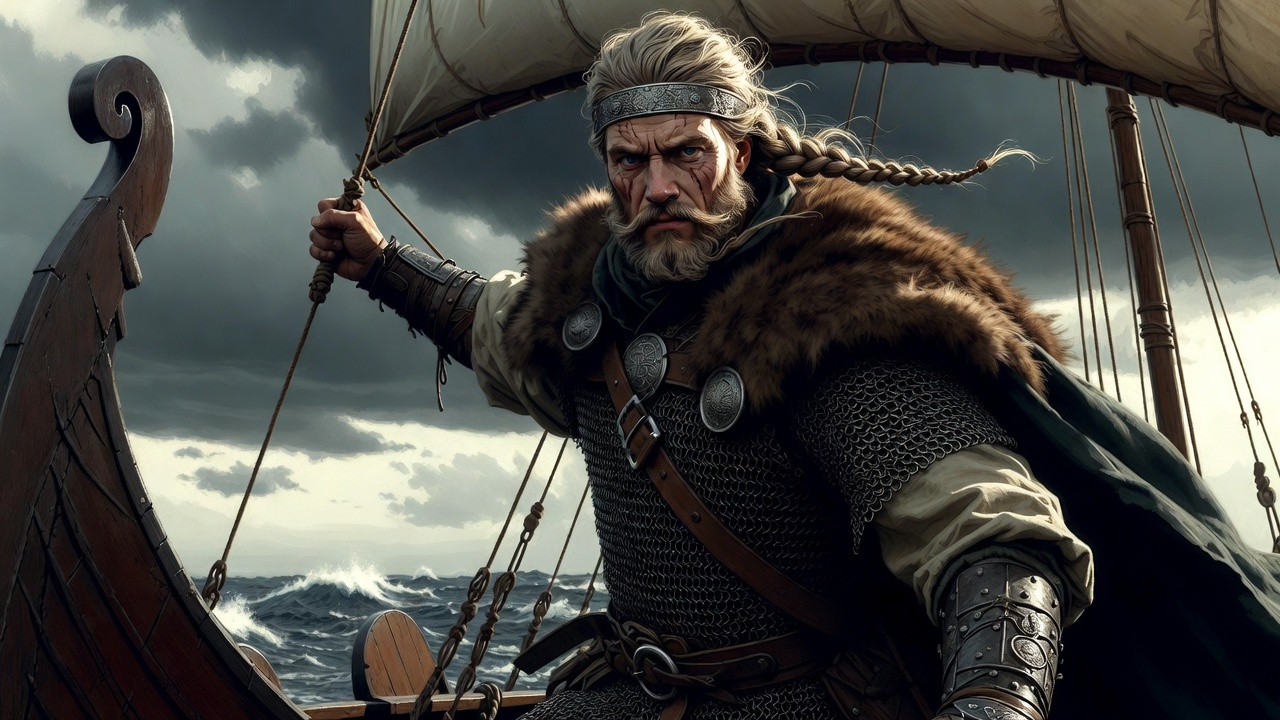
Leif Erikson Discovered America in 1000 AD: Archaeological Proof Vikings Beat Columbus by 500 Years
Introduction: The Discovery That Rewrote History
On a crisp autumn day around the year 1000 AD, a Norse explorer named Leif Erikson stepped onto the shores of what is now Newfoundland, Canada. He had no idea he was about to become the first documented European to set foot in North America—a full 492 years before Christopher Columbus would accidentally stumble into the Caribbean.
For centuries, this was dismissed as myth. Viking sagas told fantastical stories of a land called ”Vinland” where grapes grew wild and timber was abundant. Historians rolled their eyes. Surely these were just exaggerated tales, like dragons and sea monsters?
Then, in 1960, everything changed.
Norwegian explorer Helge Ingstad and his archaeologist wife Anne Stine Ingstad discovered the remains of a Norse settlement at L’Anse aux Meadows in Newfoundland. Suddenly, the sagas weren’t myths anymore. They were documented history.
This is the true story of how Leif Erikson—son of a convicted murderer and con artist—became the first European to discover America, and why it took nearly a thousand years for the world to believe it.
The Setup: Growing Up on an Ice Cube Called ”Greenland”
To understand Leif Erikson’s discovery, we need to start with his father: Erik the Red, arguably history’s greatest real estate scammer.
Context: In 982 AD, Erik Thorvaldsson (called ”Erik the Red” for his flame-colored hair and violent temper) was banished from Iceland for manslaughter. Rather than accept exile quietly, he sailed west and discovered a massive island covered in ice and glaciers. His marketing solution? Call it ”Greenland” to trick people into settling there. It worked spectacularly—and became the foundation for his son’s future explorations.
Leif Erikson was born around 970-980 AD in Iceland, but grew up in Greenland after his father’s controversial settlement in 985. Imagine being a young Viking raised on what was essentially a frozen wasteland that your father had fraudulently marketed as a paradise.
According to the Saga of Erik the Red (Eiríks saga rauða), written in the 13th century but based on earlier oral traditions, Leif grew up hearing stories from traders and explorers about lands even further west.
”Leif was a large, strong man, of very striking appearance and wise, as well as being a man of moderation in all things.”
— Eiríks saga rauða, Chapter 5
By the time Leif reached adulthood, he had heard enough. Greenland, despite its name, was harsh and limiting. But somewhere to the west lay real green land—and Leif was determined to find it.
The Catalyst: Bjarni Herjólfsson’s Accidental Sighting
Leif’s expedition didn’t begin with him. The story actually starts with a merchant named Bjarni Herjólfsson, who may have been history’s luckiest—and least curious—explorer.
The Bjarni Story (c. 986 AD):
According to the Grœnlendinga saga (Saga of the Greenlanders), Bjarni was sailing from Iceland to Greenland to visit his father when storms blew his ship off course. After days of being lost in fog, he sighted land that was clearly NOT Greenland—it had forests and low hills instead of ice and mountains.
Here’s the incredible part: Bjarni didn’t land. He refused to explore because he was worried about arriving late to his father’s house. His crew begged him to investigate this new land, but Bjarni said no and sailed away.
”Bjarni said he thought this unlikely to be Greenland… They did not put ashore there.”
— Grœnlendinga saga, Chapter 2
When Bjarni finally reached Greenland and told people what he’d seen, he was heavily criticized for his lack of curiosity. But his descriptions intrigued young Leif Erikson, who saw opportunity where Bjarni had seen inconvenience.
The Expedition: Leif Buys Bjarni’s Ship and Sails West (c. 1000 AD)
Around the year 1000, Leif Erikson decided to retrace Bjarni’s route. He purchased Bjarni’s ship (the same vessel that had sighted the mystery lands), assembled a crew of 35 men, and prepared for the voyage.
Why did Leif go?
The sagas suggest multiple motivations:
- Resources: Greenland lacked timber, a critical resource. Any land with forests would be invaluable
- Adventure: Leif had his father’s explorer blood and his own ambitions
- Reputation: Successful exploration brought prestige and wealth
- Curiosity: Simply wanting to see what lay beyond the known world
The Three Lands:
According to the sagas, Leif’s expedition encountered three distinct lands, which he named based on their characteristics:
1. Helluland (”Stone-slab Land”):
- Most likely Baffin Island in modern Canada
- Described as flat, rocky, and barren
- ”This land will not be given a good name by me,” Leif reportedly said
- No settlement attempted
2. Markland (”Forest Land”):
- Likely the Labrador coast
- Covered in forests—exactly the timber resource Greenland desperately needed
- White sandy beaches
- Leif’s crew went ashore briefly but didn’t settle
3. Vinland (”Wine Land” or ”Meadow Land”):
- likely Newfoundland, possibly extending to New Brunswick
- This is where Leif chose to settle
Vinland: The Land of Wild Grapes and Endless Timber
When Leif and his crew landed in Vinland, they encountered a landscape utterly unlike anything in Greenland or Iceland:
What the Sagas Describe:
- Wild grapes or berries (hence ”Vinland”)
- Abundant timber—massive trees compared to Greenland’s scrubland
- Rivers teeming with salmon
- Mild climate—grass didn’t frost in winter
- No snow, or very little
”There was no lack of salmon both in the river and in the lake, and it was bigger salmon than they had ever seen before.”
— Eiríks saga rauða, Chapter 8
The Name Debate:
Scholars debate what ”Vinland” actually means:
- Traditional interpretation: ”Wine Land” (vín = wine), referring to wild grapes
- Alternative theory: ”Meadow Land” (vín = meadow in Old Norse), referring to grasslands
- Reality: Probably wild berries that could ferment, not true grapes
For Vikings from Greenland, where growing seasons were measured in weeks and timber was nearly nonexistent, Vinland must have seemed like paradise.
The Settlement: Building Leifsbudir (Leif’s Booths)
Leif’s expedition built a settlement they called Leifsbudir (”Leif’s booths” or temporary shelters). According to the sagas:
”They carried their leather sleeping bags ashore and built big houses there.”
— Grœnlendinga saga, Chapter 3
What They Built:
- Large timber halls (longhouses)
- Workshops for iron working and ship repairs
- Storage buildings for timber and resources
- Defensive positions
The settlement was intended as a base camp for resource extraction, particularly timber, which could be transported back to Greenland. Unlike later European colonization, this wasn’t about permanent conquest—it was about strategic resource acquisition.
How Long Did Leif Stay?
The sagas indicate Leif spent one winter in Vinland before returning to Greenland with a cargo of timber and ”grapes” (likely berries). His voyage was considered a tremendous success.
The Archaeological Proof: L’Anse aux Meadows
For nearly 800 years, Leif Erikson’s Vinland remained a story. Then came 1960.
The Discovery:
Norwegian explorer Helge Ingstad was obsessed with finding Vinland. He believed that if it existed, it would be on the northern tip of Newfoundland—the first hospitable land Vikings would encounter sailing south from Greenland.
In 1960, following local rumors of ”Indian ruins,” Ingstad and local resident George Decker located unusual ridges at L’Anse aux Meadows. Over the next seven years, Ingstad and his wife Anne Stine (a trained archaeologist) excavated the site.
What They Found:
L’Anse aux Meadows Archaeological Evidence:
Structures:
- Eight Norse-style buildings (sod walls, timber frames)
- Three residential halls (similar to Greenland and Iceland longhouses)
- Four workshops
- One forge with Norse-style iron slag
Artifacts:
- Iron rivets identical to those used in Viking ships
- Soapstone spindle whorl (for spinning wool—a Norse activity)
- Bronze pin of Norse design
- Jasper strike-a-light (fire-starting tool)
- Bone needles
- Iron nails and boat rivets
Dating:
- Radiocarbon dating: 990-1050 AD
- Dendrochronology (tree-ring dating): Confirms occupation around 1000 AD
- Matches saga timeline perfectly
Significance:
- Only confirmed Viking settlement in North America
- Pre-dates Columbus by approximately 492 years
- UNESCO World Heritage Site (designated 1978)
Why This Site is Definitely Norse:
Dr. Birgitta Wallace, the Parks Canada archaeologist who studied L’Anse aux Meadows for decades, points out several conclusive factors:
- Architecture: Building techniques identical to Norse Greenland/Iceland, completely different from Indigenous structures
- Iron Production: Indigenous peoples of Newfoundland didn’t smelt iron; this is definitively European
- Artifacts: Soapstone from Greenland, jasper from Iceland/Greenland
- Dating: Perfect chronological match with saga accounts
- Location: Exactly where Vikings would build a base camp for further exploration
”L’Anse aux Meadows is unquestionably a Norse site. There is no other explanation that fits the evidence.”
— Dr. Birgitta Wallace, Studies in Viking and Medieval Archaeology (2003)
Was L’Anse aux Meadows Actually ”Vinland”?
Here’s where it gets complicated. L’Anse aux Meadows was probably NOT the ”Vinland” described in the sagas—at least not the main settlement.
The Evidence:
- Grapes Don’t Grow There: Wild grapes don’t grow as far north as Newfoundland. The sagas emphasize grapes/wine as Vinland’s defining feature.
- Size Mismatch: L’Anse aux Meadows could house maybe 70-90 people at most. The sagas describe larger, more permanent-feeling settlements.
- Short Occupation: Archaeological evidence suggests L’Anse aux Meadows was occupied for only a few years, possibly just one or two seasons.
The Theory:
Most archaeologists now believe L’Anse aux Meadows was a gateway settlement—a base camp from which Vikings explored further south. ”Vinland” proper was likely:
- New Brunswick (wild grapes grow there)
- Maine (grapes, milder climate)
- Possibly even further south
L’Anse aux Meadows served as:
- A ship repair station
- A timber processing base
- A launching point for expeditions to warmer, more resource-rich areas south
Dr. Wallace’s research on iron production shows the site specialized in manufacturing boat rivets—suggesting it was primarily a maritime industrial site rather than a farming settlement.
The Indigenous Encounter: First Contact
The sagas don’t shy away from describing Viking encounters with the Indigenous peoples of North America, whom they called ”Skrælings” (a derogatory term roughly meaning ”wretches” or ”barbarians”).
From the Grœnlendinga Saga:
”Early one morning when they looked about, they saw a great number of skin-boats [kayaks]; staves were being swung from the boats which sounded like a flail being used when corn is being threshed—and their motion was sunwise.”
— Grœnlendinga saga, Chapter 7
What the Sagas Describe:
Initial Contact (Peaceful?):
- Indigenous peoples approached in boats
- Some trade occurred (furs for red cloth, which the sagas say the natives valued highly)
- Curiosity on both sides
Escalation (Violence):
- A Viking bull escaped and frightened the visitors
- Subsequent encounters turned hostile
- Skirmishes broke out
- Vikings were vastly outnumbered
The Indigenous Perspective:
We have no written Indigenous accounts of these encounters, but archaeological and oral tradition evidence suggests:
- Probable groups: Ancestors of the Beothuk people (now extinct) or Dorset culture peoples
- Technology: Stone and bone tools, skin boats, sophisticated Arctic survival skills
- Population advantage: Thousands vs. dozens of Vikings
- Home territory advantage: Intimate knowledge of landscape, weather, resources
Why the Vikings Left:
The sagas make it clear: the Vikings couldn’t maintain a permanent settlement because they were vastly outnumbered. Unlike later European colonizers who arrived with diseases that decimated Indigenous populations, the Vikings had no such advantage.
”Karlsefni and his men had realized by now that although the land was excellent, there would always be fear and strife dogging them there on account of those who already inhabited it.”
— Eiríks saga rauða, Chapter 11
This is a crucial historical point: the Vikings tried to colonize North America and FAILED. Indigenous resistance prevented permanent European settlement for another 500 years.
After Leif: Subsequent Expeditions
Leif Erikson’s successful voyage inspired several follow-up expeditions:
1. Thorvald Eriksson (Leif’s Brother, c. 1004):
- Took Leif’s ship back to Vinland
- Explored extensively, including areas south of L’Anse aux Meadows
- Killed in conflict with Indigenous peoples—possibly the first European to die in America
- Buried in Vinland (location unknown)
2. Thorfinn Karlsefni (c. 1009-1011):
- Large expedition with 160 people, including women
- Attempted permanent settlement
- Snorri Thorfinnsson born there—first European child born in America
- Abandoned after 2-3 years due to Indigenous conflicts
3. Freydís Eiríksdóttir (Leif’s Half-Sister, c. 1014):
- Led (or co-led) expedition to Vinland
- Saga describes her fighting off Indigenous attack while pregnant
- Also describes her murdering business partners in a dispute
- Returned to Greenland, ended Vinland expeditions
Why Did Vinland Fail When Later European Colonies Succeeded?
This is one of history’s most important questions. The Viking Vinland settlements lasted only about 10-15 years total across multiple expeditions. Yet 500 years later, European colonization succeeded permanently. Why?
Factors That Doomed Viking Vinland:
1. Population Disadvantage:
- Vikings: Dozens to low hundreds
- Indigenous peoples: Thousands
- No disease advantage (unlike 1492+)
2. Distance from Home:
- Greenland to Vinland: ~2,000 miles across dangerous waters
- Supply lines nearly impossible to maintain
- No reinforcements available quickly
3. Greenland’s Weakness:
- The ”home base” was itself struggling
- Population of Greenland never exceeded ~5,000
- Couldn’t spare people for colonization
4. Economic Model:
- Vikings wanted resources (timber, furs), not land
- When Indigenous resistance made resource extraction dangerous, the value proposition collapsed
- Not worth dying for lumber when Iceland had some
5. No Crown Support:
- Unlike Spanish/English/French colonization, no state backing
- Individual/family ventures only
- No military support available
6. Indigenous Resistance:
- Organized, effective defense of territory
- Superior numbers
- Knowledge of terrain
- Successful prevention of European foothold
Why 1492+ Succeeded:
- Disease: Smallpox, measles, etc. killed 90% of Indigenous populations
- State backing: Massive resources from European crowns
- Technology gap: 500 years of advancement (guns, steel, horses)
- Ideological drive: Religious conversion mission + capitalism
- Sustained effort: Continuous waves of colonizers
The Vikings’ failure in Vinland is actually a testament to Indigenous peoples’ successful defense of their homelands when they weren’t devastated by disease.
Leif Erikson’s Later Life and Legacy
After his Vinland expedition, Leif Erikson never returned to North America. Why?
The Saga Account:
”Leif said to his father Erik, ’I intend now, father, to voyage to Greenland.’ Erik replied, ’I am too old now. I am less able to endure hardships than I once was.’”
— Eiríks saga rauða, Chapter 5
What Happened to Leif:
After returning from Vinland with a cargo of timber and ”wine,” Leif inherited his father’s position as chief of the Greenland settlement when Erik the Red died around 1003.
Later Life:
- Became ruler of Greenland settlements
- Never personally returned to Vinland (delegated to siblings and others)
- Converted to Christianity (possibly influenced by King Olaf Tryggvason of Norway)
- Attempted to Christianize Greenland
- Died sometime between 1019-1025 AD
Historical Footprint:
Unlike Columbus, who made four voyages and spent years in the Caribbean, Leif made one voyage to America, spent one winter there, and never returned. Yet his discovery was arguably more significant because it proved the concept centuries earlier.
The Forgetting: Why Did Europe Lose This Knowledge?
Here’s the mind-blowing part: Europeans KNEW about Vinland for centuries, then forgot.
The Timeline of Forgetting:
1000-1350 AD: Knowledge preserved in Iceland
- Sagas written down in 13th century
- Icelanders remembered Vinland
- Some trade/contact may have continued sporadically
1350-1500: Knowledge fades
- Black Death devastates Iceland and Scandinavia (1347-1351)
- Greenland Norse settlements collapse (abandoned by 1450s)
- Iceland falls under Norwegian/Danish control
- Sagas preserved but dismissed as mythology
1492+: Columbus claims ”discovery”
- No one in southern Europe knew about Vinland
- Iceland’s knowledge ignored or unknown
- Columbus’s ”discovery” accepted as first
Why the Knowledge Was Lost:
- Greenland’s Collapse: When the base settlements died out, the connection was severed
- Geographic Isolation: Iceland was peripheral to European power centers
- Language Barrier: Sagas were in Old Norse, unread by most Europeans
- Mythologization: Fantastic elements in sagas (like Uniped creatures) made scholars dismiss everything as fiction
- No Strategic Value: With Greenland gone, no reason to remember distant timber sources
- Political Irrelevance: Iceland had no power to assert historical claims
The Rediscovery: How Leif’s Story Came Back
The rehabilitation of Leif Erikson as a legitimate historical figure took centuries:
1837: Danish scholar Carl Christian Rafn publishes Antiquitates Americanae
- First scholarly argument that sagas described real place
- Proposed Vinland was in North America
- Widely dismissed by establishment historians
1960: Ingstad discovers L’Anse aux Meadows
- Physical proof of Norse presence
- Academic consensus shifts dramatically
1964: U.S. Congress designates October 9 as Leif Erikson Day
- Recognizing Norse discovery before Columbus
- Largely symbolic, less celebrated than Columbus Day
2000: Millennium anniversary celebrations
- Iceland and Newfoundland commemorate 1000th anniversary
- Major academic conferences
- PBS documentary ”The Vikings”
2021: Columbus Day increasingly controversial
- Many U.S. cities rename it ”Indigenous Peoples’ Day”
- Leif Erikson Day gains prominence as alternative
- Shift in historical narrative toward more accurate, inclusive history
Modern Significance: Why Leif Erikson Matters Today
1. Correcting Historical Narratives:
The Leif Erikson story challenges Eurocentric history:
- Columbus didn’t ”discover” America (Indigenous peoples were there for 15,000+ years)
- Columbus wasn’t even the first European (Leif beat him by 500 years)
- ”Discovery” is a problematic concept (you can’t discover inhabited lands)
2. Indigenous Resistance:
The Viking failure in Vinland demonstrates that Indigenous peoples successfully defended their territories when not devastated by disease. This challenges narratives of inevitability around European colonization.
3. Climate and Settlement:
The Greenland Norse settlements’ collapse around 1450 (due to climate change during the Little Ice Age) provides modern lessons about:
- Climate adaptation vs. cultural rigidity
- Sustainability of settlements in marginal environments
- The Greenland Norse refused to adopt Inuit survival strategies and died out as a result
4. Archaeological Science:
L’Anse aux Meadows represents a triumph of combining:
- Traditional knowledge (saga literature)
- Archaeological method
- Scientific dating techniques
- Cross-disciplinary research
5. Cultural Pride:
For Scandinavian-Americans and Canadians, Leif Erikson represents:
- Nordic contribution to North American history
- Alternative to Columbus-centered narrative
- Source of cultural identity and heritage
Unanswered Questions and Ongoing Research
Despite decades of research since L’Anse aux Meadows, major questions remain:
1. Where Was the ”Real” Vinland?
- Was it further south (New Brunswick, Maine)?
- How far south did Vikings explore?
- Are there undiscovered Norse sites waiting to be found?
2. How Long Did Contact Continue?
- Did Vikings return to North America after 1014?
- Evidence of Norse artifacts in Indigenous sites suggests possible ongoing contact
- Did knowledge of the route survive in Greenland until the settlements’ collapse?
3. Did Viking-Indigenous Mixing Occur?
- Some genetic studies suggest possible Norse DNA in some Indigenous populations
- Highly controversial and debated
- More research needed with Indigenous community consent and participation
4. What Other Evidence Exists?
- Norse coins found in Maine (possibly brought by Indigenous trade networks)
- Alleged ”Viking” artifacts throughout North America (mostly debunked, some uncertain)
- Are there sunken Norse ships in North American waters?
Current Research:
- Satellite archaeology: Using satellite imagery to identify potential Norse sites
- Genetic studies: Examining both European and Indigenous populations for evidence of contact
- Climate reconstruction: Understanding Medieval Warm Period conditions that made voyages possible
- Experimental archaeology: Recreating Viking ships and voyages to understand feasibility
Conclusion: The Explorer Who Changed History (Quietly)
Leif Erikson’s achievement is remarkable precisely because it was so… quiet.
Unlike Columbus, whose voyages triggered immediate, catastrophic, and permanent changes for Indigenous peoples, Leif’s expedition:
- Lasted one winter
- Resulted in limited follow-up
- Failed to establish permanent settlement
- Was forgotten for 500 years
- Changed almost nothing… immediately
Yet in historical terms, Leif Erikson proved something profound: the Atlantic was crossable. Europeans could reach North America. The barrier wasn’t technological or geographic—it was social, economic, and demographic.
If Greenland had been more populous, if Viking shipbuilding had continued advancing, if the Medieval Warm Period had lasted longer, the entire history of European-American contact might have unfolded differently. Indigenous peoples might have had 500 more years to develop immunity to European diseases, or European states might have arrived to find consolidated Indigenous empires that couldn’t be toppled by a few hundred conquistadors.
History turned on these contingencies.
Today, as we reassess Columbus’s legacy and grapple with the true history of colonization, Leif Erikson offers an important corrective: the Viking who discovered America, respected (or at least acknowledged) Indigenous resistance enough to leave, and whose story reminds us that history is far more complex than the myths we tell ourselves.
Leif Erikson didn’t ”discover” America. Indigenous peoples had been there for fifteen millennia. But he was the first European to set foot there, document it, and prove it could be done.
That’s a legacy worth remembering—and worth getting right.
Sources & References:
Primary Medieval Sources:
- Grœnlendinga saga (Saga of the Greenlanders), 13th century
- Eiríks saga rauða (Saga of Erik the Red), 13th century
- Landnámabók (Book of Settlements), 12th century compilation
Archaeological Sources:
- Ingstad, H. & Ingstad, A.S. (2001). The Viking Discovery of America: The Excavation of a Norse Settlement in L’Anse aux Meadows. Checkmark Books
- Wallace, B. (2003). ”L’Anse aux Meadows and Vinland: An Abandoned Experiment.” Studies in Viking and Medieval Archaeology
- Wallace, B. (2009). ”The Discovery of Vinland.” The Viking World, Routledge
Academic Studies:
- Seaver, K. (1996). The Frozen Echo: Greenland and the Exploration of North America. Stanford University Press
- Fitzhugh, W. & Ward, E. (2000). Vikings: The North Atlantic Saga. Smithsonian Institution Press
- Arneborg, J. & Grønnow, B. (eds.) (2006). Dynamics of Northern Societies. National Museum of Denmark
- Kuitems, M. et al. (2021). ”Evidence for European presence in the Americas in AD 1021.” Nature 601, 388-391
Modern Analyses:
- Pringle, H. (2012). ”Evidence of Viking Outpost Found in Canada.” National Geographic
- Parks Canada. (2021). ”L’Anse aux Meadows: A Norse Settlement in North America”
Call-to-Action:
Did you know Vikings reached America 500 years before Columbus? Share this with someone who still thinks Columbus ”discovered” America!
📺 Watch our Viking Saga series: Complete 7-part documentary covering Erik the Red through Navigation Secrets.
🎵 Listen to the epic soundtrack: BLÓÐ Í HÖFUNUM – The Viking Saga anthem (English/Old Norse mix)
💬 Join the discussion: Was Leif Erikson’s ”discovery” any different morally from Columbus’s? Should we celebrate explorers at all? Share your thoughts below!
Related Articles:
- [Previous] Erik the Red’s Greenland Scam: The Marketing Genius of 982 AD
Lämna ett svar