
A Name That Launched a settlement (and One Massive Lie)
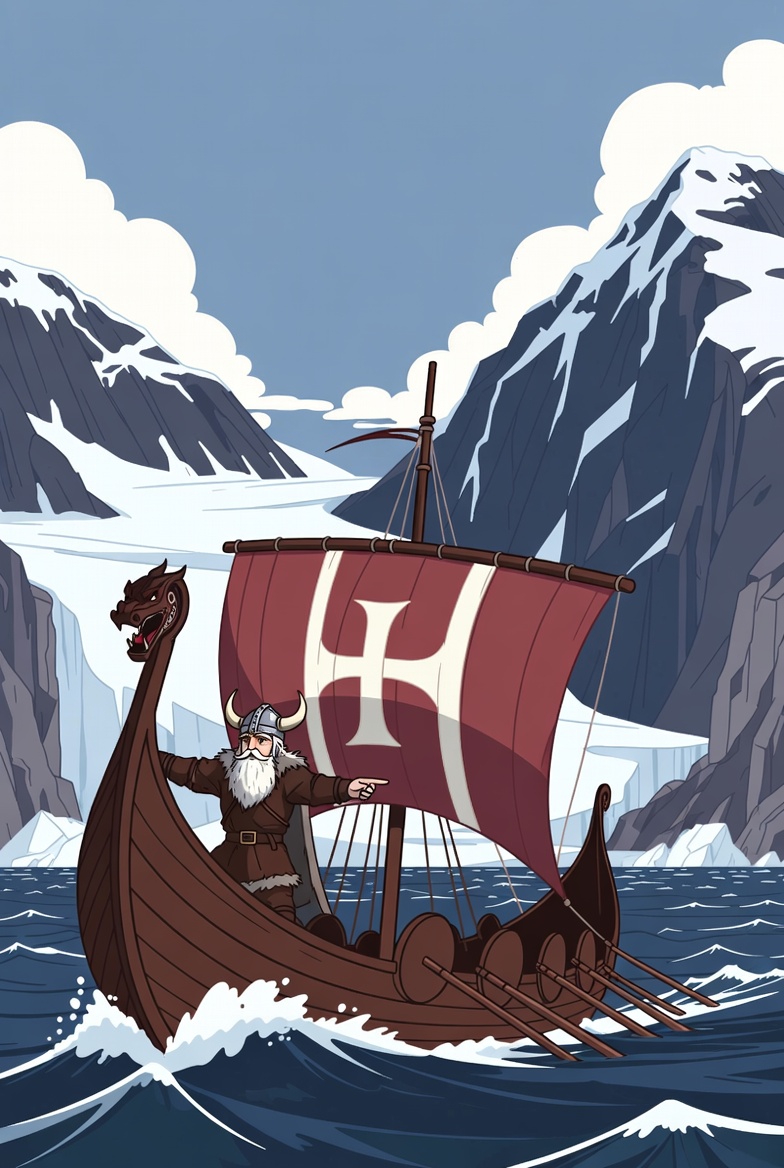
In 982 AD, a red-haired Viking named Erik Thorvaldsson committed what might be history’s most audacious act of false advertising. After being banished from Iceland for manslaughter, he sailed west and discovered a land covered in ice, glaciers, and polar bears. His brilliant marketing solution? Call it Greenland.
The scam worked spectacularly. Hundreds of Vikings packed up their lives, expecting lush farmland and mild weather. What they found was one of the harshest environments on Earth. Yet this deception led to a 500-year Norse settlement that changed the course of North Atlantic exploration.
This is the story of Erik the Red—part explorer, part con artist, and the man who proved that branding matters more than truth.
The Banishment: How Violence Led to Discovery
Erik Thorvaldsson, better known as Erik the Red due to his flame-colored hair and fiery temper, was no stranger to trouble. Born in Norway around 950 AD, his family was exiled to Iceland after his father Thorvald committed manslaughter (Íslendingabók, medieval Icelandic historical text).
Historical Context: Viking Iceland operated under a unique legal system where disputes were settled through Thing assemblies and banishment was a common punishment for serious crimes. Erik’s case was heard at the Althing, Iceland’s parliamentary gathering established in 930 AD.
Iceland, however, proved too small for Erik’s temperament. According to the Saga of Erik the Red (Eiríks saga rauða), compiled in the 13th century from earlier oral traditions, Erik became involved in a blood feud around 982 AD. After killing several men in disputes over property and lending, he was sentenced to three years of outlawry—effectively banishment from Icelandic society.
Rather than skulk away in shame, Erik saw opportunity. Norse sailors had reported glimpsing land to the west during storms. Erik decided to find it.
The Discovery: Finding the Ice Cube
In 982 AD, Erik the Red sailed west from Iceland with a small crew. After several days at sea, they encountered the eastern coast of what is now Greenland. Contemporary sources describe what he found:
”They found a land that was mostly ice and rock, with deep fjords cutting into the coast. In some protected valleys, there was grass and low vegetation during the brief summer months.” — Landnámabók (Book of Settlements), 12th century
The reality of Greenland was harsh:
Climate Facts (Medieval Warm Period, 950-1250 AD):
- Summer temperatures: 40-50°F (4-10°C) in coastal areas
- Winter temperatures: -20 to -40°F (-29 to -40°C)
- Ice sheet coverage: ~80% of the landmass
- Growing season: Approximately 3 months
- Vegetation: Mainly low grasses, mosses, and dwarf shrubs
Erik spent three years exploring Greenland’s western coast, mapping fjords and identifying the few areas where livestock grazing might be possible. The southwestern coast, warmed slightly by ocean currents, offered marginal but viable settlement locations.
According to archaeological evidence from sites like Brattahlíð (Erik’s own farm) and the Hvalsey Church ruins, these settlements were indeed established in relatively ”green” valleys—though ”green” is generous by any Mediterranean standard.
The Con: Marketing Ice as Paradise
Here’s where Erik’s genius—or fraud—becomes evident. When his three-year banishment ended in 985 AD, he returned to Iceland with a plan. He would recruit settlers for his new discovery. But who would voluntarily move to a frozen wasteland?
Erik’s solution was pure marketing innovation: branding.
”He named the land Greenland, saying that people would be more eager to go there if it had an attractive name.” — Íslendingabók (Book of Icelanders), Ari Þorgilsson, c. 1125 AD
This wasn’t subtle misdirection—it was calculated deception. Iceland, despite its icy name, actually had significant green farmland. Greenland, despite its verdant name, was predominantly ice. Erik essentially reversed the truth.
The Marketing Strategy:
- Name recognition: ”Greenland” evoked fertile, habitable land
- Comparison marketing: Positioned it as superior to Iceland
- Selective information: Emphasized the few green fjords, omitted the massive ice sheet
- Social proof: Erik’s own reputation as a successful explorer lent credibility
- Urgency: Limited farmland available (actually true—very limited!)
The Settlement: Success Built on Deception
Against all odds, Erik’s marketing campaign worked brilliantly. In 985-986 AD, approximately 25 ships left Iceland carrying settlers, livestock, supplies, and dreams of prosperity. According to the sagas, only 14 ships survived the treacherous North Atlantic crossing.
Those who arrived found… exactly what Erik had discovered: a frozen land with small pockets of marginal farmland.
The Norse Greenland Settlement (985-1450s AD):
Eastern Settlement (Eystribyggð):
- Location: Modern-day Qaqortoq region
- Population peak: ~4,000 people
- Key site: Brattahlíð (Erik’s farm, now Qassiarsuk)
- Economy: Livestock farming, seal hunting, walrus ivory trade
Western Settlement (Vestribyggð):
- Location: Nuuk fjord region
- Population peak: ~1,000 people
- Abandoned: c. 1360 AD
- Economy: Hunting, limited agriculture
Despite the harsh conditions, the settlement persisted for nearly 500 years. How?
Survival Strategies:
- Livestock: Sheep, goats, and cattle (though fodder was chronically scarce)
- Hunting: Seals, walrus, caribou, and seabirds provided essential protein
- Trade: Walrus ivory, polar bear pelts, and live falcons exported to Europe
- European connection: Maintained cultural and religious ties with Norway and the Catholic Church
Archaeological evidence from sites like the Farm Beneath the Sand (GUS) reveals that Greenlanders supplemented their diet with up to 80% marine resources—far more than typical Norse farming communities (Arneborg et al., 1999, ”Change of Diet of the Greenland Vikings,” Journal of Archaeological Science).
The Historical Verdict: Fraud or Frontier Ingenuity?
Modern historians debate whether Erik the Red was a con artist or simply an optimistic promoter. The truth likely lies somewhere between.
Arguments for ”Scam”:
- The name was deliberately misleading
- He knew the harsh reality but emphasized only positives
- Settlers were unprepared for the actual conditions
- Many likely wouldn’t have gone if truthfully informed
Arguments for ”Legitimate Settlement”:
- The settlements did survive for 500 years
- Some areas were genuinely ”green” by Arctic standards
- Medieval Warm Period made settlement viable (if difficult)
- All colonization involves promotional exaggeration
”Erik the Red’s naming of Greenland was certainly optimistic marketing, but the Norse did successfully establish permanent settlements there for half a millennium. By medieval standards, that’s a successful colony” (Arneborg, 2015, ”The Norse Settlements in Greenland”, The Viking World 2008).
The Collapse: When the Ice Won
The Norse Greenland settlements ultimately failed, though the timeline and causes remain debated.
Timeline of Decline:
- c. 1360: Western Settlement abandoned
- c. 1450s: Eastern Settlement abandoned
- 1540s: Last recorded European contact finds settlements deserted
Contributing Factors:
- Climate Change (Little Ice Age, c. 1300-1850)
- Temperatures dropped 2-4°F
- Shorter growing seasons made agriculture nearly impossible
- Sea ice blocked shipping routes to Europe
- Economic Isolation
- Walrus ivory trade collapsed (African elephant ivory became available)
- Black Death (1347-1351) devastated Norway, their main trading partner
- European interest in Greenland waned
- Resource Depletion
- Overgrazing damaged fragile ecosystems
- Deforestation eliminated scarce timber resources
- Soil erosion reduced already limited farmland
- Cultural Rigidity
- Norse refused to adopt Inuit survival strategies (kayaks, seal hunting techniques)
- Maintained European farming focus despite unsuitable environment
- Cultural pride prevented adaptation (Diamond, 2005, Collapse)
The Thule people (ancestors of modern Greenlandic Inuit), who arrived around 1200 AD, thrived in the same environment where Norse settlers struggled, largely because their culture was specifically adapted to Arctic hunting rather than farming.
Erik’s Legacy: The Explorer Who Opened the Atlantic
Despite—or perhaps because of—his fraudulent marketing, Erik the Red’s impact on history was profound.
Direct Consequences:
- Permanent Settlement: 500-year Norse presence in the Americas
- Atlantic Navigation: Established sailing routes still used today
- Vinland Expeditions: His son Leif Erikson used Greenland as a base to reach North America c. 1000 AD
- Geographic Knowledge: Extended European understanding of the North Atlantic
Historical Connections:
- Greenland served as a waypoint for Norse exploration of North America
- Archaeological sites like L’Anse aux Meadows (Newfoundland) prove Norse presence in America 500 years before Columbus
- Norse knowledge of Atlantic routes may have influenced later European explorers
The Grœnlendinga saga and Saga of Erik the Red preserve accounts of Leif Erikson’s voyages to ”Vinland” (likely Newfoundland/Labrador), establishing Norse presence in North America by 1000 AD—a fact confirmed by archaeological evidence discovered in 1960.
Modern Greenland: The Ultimate Irony
The final irony? Modern climate change is making Erik the Red’s false advertising increasingly accurate.
Contemporary Greenland:
- Ice sheet melting at accelerating rates (Mouginot et al., 2019, PNAS)
- Increased vegetation in coastal areas
- Extended growing seasons allowing experimental agriculture
- Some scientists predict ice-free summers within centuries
In a twist Erik could never have imagined, ”Greenland” might actually become green.
The abandoned Norse farms are now tourist sites. Modern Greenlanders—predominantly Inuit—live in a self-governing territory of Denmark with a population of about 56,000. Ironically, many live in the same fjords Erik’s settlers once occupied.
Conclusion: The Salesman Who Changed History
Erik the Red’s Greenland deception remains one of history’s most successful—and consequential—marketing campaigns. He lied about ice being green, convinced hundreds to uproot their lives based on that lie, and accidentally established a foothold that led to European discovery of North America.
Was he a con artist? Undoubtedly. Did his scam work? For 500 years, yes. Did it change the course of exploration? Absolutely.
In the end, Erik the Red proves a timeless truth: sometimes the biggest discoveries come from the most audacious lies. And sometimes, the best way to sell a frozen wasteland is to simply call it something else.
Sources & References:
Primary Medieval Sources:
- Íslendingabók (Book of Icelanders), Ari Þorgilsson, c. 1125 AD
- Landnámabók (Book of Settlements), 12th century compilation
- Eiríks saga rauða (Saga of Erik the Red), 13th century
- Grœnlendinga saga (Saga of the Greenlanders), 13th century
Academic Sources:
- Arneborg, J. (2008). ”The Norse Settlements in Greenland.”
The Viking World, 2008 - Arneborg, J., et al. (1999). ”Change of diet of the Greenland Vikings determined from stable carbon isotope analysis and 14C dating of their bones” Radiocarbon: An International Journal of Cosmogenic Isotope Research 41(2), 157-168
- Diamond, J. (2005). Collapse: How Societies Choose to Fail or Succeed. Penguin Group USA
- Seaver, K. (1997). The Frozen Echo: Greenland and the Exploration of North America. Stanford University Press
- Lynnerup, N. (1998). The Greenland Norse: A Biological-Anthropological Study. Vol. 24 (1998): Meddelelser om Grønland. Man & Society
- Dugmore, A. J., et al. (2012). ”Cultural adaptation, compounding vulnerabilities and conjunctures in Norse Greenland.” University of Nottingham,
- Mouginot, J., et al. (2019). ”Forty-six years of Greenland Ice Sheet mass balance.” PNAS, 116(19), 9239-9244
Museums & Archaeological Resources:
- National Museum of Denmark: Norse Greenland Collection
- Greenland National Museum & Archives, Nuuk
- L’Anse aux Meadows National Historic Site, Newfoundland
Call-to-Action:
Did Erik the Red’s story surprise you? Share this article with someone who thinks Columbus discovered America!
👉 Follow us on Twitter | Instagram | Youtube for more historical revelations that challenge what you learned in school.
📚 Subscribe to our Youtube channel for more deep-dives into history’s greatest frauds, failures, and forgotten heroes.
💬 Join the discussion: Was Erik the Red a con artist or an optimistic entrepreneur?
Lämna ett svar