
Viking Berserkers: Elite Warriors Who Fought in Battle-Trance – Science Explains How They Did It
Introduction: The Warriors Who Became Legends
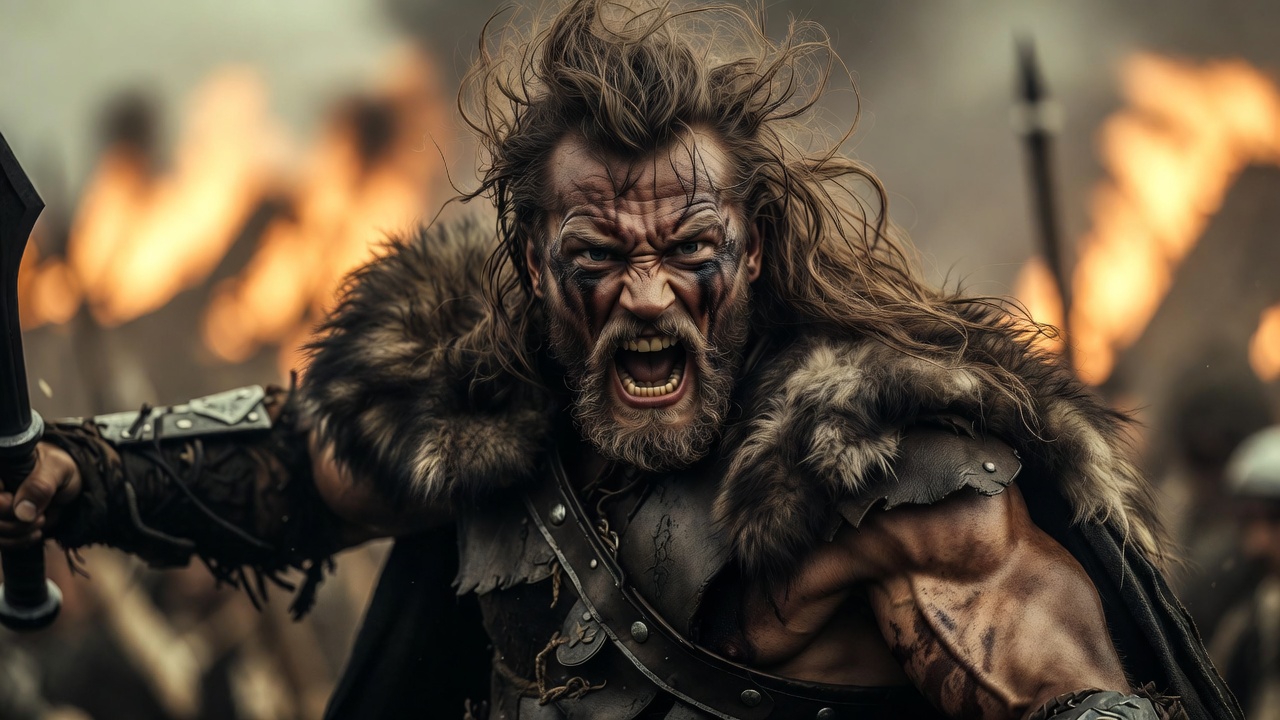
Imagine facing an enemy who charges into battle wearing only animal skins, screaming like a wild beast, biting his shield in fury, and seemingly immune to pain. Arrows bounce off him—or pierce his flesh, but he doesn’t even slow down. He fights with the strength of ten men, his eyes rolled back, foam dripping from his mouth. He is beyond reason, beyond fear, beyond humanity itself.
You are facing a berserker.
For centuries, these elite Viking warriors were dismissed as mythology—exaggerated tales meant to scare children and enemies alike. Norse sagas described them in terms that seemed supernatural:
”His men went without coats of mail, and were frantic as dogs or wolves; they bit their shields and were as strong as bears or bulls; they slew men, but neither fire nor iron could hurt them.”
— Ynglinga saga, Chapter 6, Snorri Sturluson (c. 1225 AD)
Surely, historians scoffed, this was fantasy. No human could actually fight in such a state. The berserker was just a metaphor for extreme bravery or a literary device to make heroes seem more impressive.
Then modern science began to catch up with medieval legend.
Today, researchers have proposed multiple evidence-based theories for how berserkers achieved their legendary battle-trance: psychoactive mushrooms, genetic pain disorders, psychological conditioning, or some combination of all three. The berserker wasn’t supernatural—he was the Viking Age’s version of a special forces operator using every tool available, including altered states of consciousness, to become an unstoppable warrior.
This is the true story of the berserkers: who they were, how they fought, what gave them their power, and why the very word ”berserk” still means ”out of control rage” in modern English over a thousand years later.
The Etymology: What Does ”Berserker” Actually Mean?
The word ”berserker” comes from Old Norse ”berserkr” (plural: berserkir), which most scholars translate as:
ber-serkr = ”bear-shirt” or ”bear-skin”
- ber/bjorn = bear
- serkr = shirt, coat, or skin
<div class=”etymology-box”> <strong>Alternative Theory:</strong> Some scholars argue it could mean <strong>”bare-shirt”</strong> (as in shirtless/naked), referring to berserkers fighting without armor. However, saga descriptions consistently mention animal skins, making ”bear-shirt” the more accepted interpretation. </div>
Why ”bear”?
In Norse culture, bears represented:
- Ultimate strength – the most powerful animal in Scandinavia
- Ferocity – unpredictable and dangerous when provoked
- Transformation – the ability to tap into primal, animalistic power
Berserkers were associated with bears, but also with wolves (úlfheðnar – ”wolf-skins”). Both symbolized warriors who had transcended normal human limitations by channeling animal fury.
The term entered English around the early 19th century, and by the mid-1800s, ”going berserk” meant losing control in a violent rage—a meaning that persists today.
Historical Sources: What the Sagas Tell Us
Our knowledge of berserkers comes primarily from medieval Icelandic sources written 200-400 years after the Viking Age:
Primary Sources:
1. Ynglinga saga (c. 1225) – Snorri Sturluson: The most famous description:
”Odin’s men went without mailcoats and were frantic as dogs or wolves; they bit their shields and were as strong as bears or bulls; they slew men, but neither fire nor iron could hurt them. This is called ’going berserk.’”
— Chapter 6
2. Egil’s Saga (c. 1230): Describes Egil Skallagrímsson’s father and grandfather as having berserker tendencies:
”Kveldulf was a great landowner and a powerful man… In the evening, he would become so savage that few dared speak to him.”
3. Vatnsdœla saga (c. 1270): Mentions berserkers as elite bodyguards for kings and jarls
4. Hrólfs saga kraka (c. 1400): Describes berserkers in King Hrolf’s service:
”They went without coats of mail and were mad as hounds or wolves; they bit their shields and were as strong as bears or wild bulls; men they slew, and neither fire nor iron took hold of them.”
5. Anglo-Saxon Chronicle (c. 1070s): English sources describe Viking berserkers in the Great Heathen Army:
”The heathen army came rushing forth like wolves, and such was their fury that Christians fled before them.”
Common Themes Across Sources:
✓ Fighting without armor or with minimal protection
✓ Animal skins (bear or wolf)
✓ Pre-battle frenzy (biting shields, howling, shaking)
✓ Seeming invulnerability to pain
✓ Superhuman strength
✓ Post-battle exhaustion or weakness
✓ Association with Odin, the god of war and ecstasy
Who Were the Berserkers? Elite Warriors, Not Common Vikings
Critical Context: Berserkers were NOT typical Vikings. They were a specialized warrior elite.
Social Role:
Royal Bodyguards:
- Norwegian and Swedish kings employed berserkers as personal guards
- Elite shock troops deployed at critical battle moments
- Symbol of royal power and martial prowess
Ship Prows:
- Berserkers often fought at the bow (front) of longships
- First to board enemy vessels in naval combat
- Psychological warfare – their appearance alone could break enemy morale
Temple Guardians:
- Some sources suggest berserkers guarded sacred sites
- Connection to Odin worship
- Ritual/religious dimension to their role
Mercenaries:
- Hired by jarls and chieftains for specific battles
- Expensive but devastating when deployed correctly
- Could determine the outcome of otherwise evenly matched conflicts
Training and Selection:
Becoming a berserker wasn’t random. Sources suggest:
- Hereditary component – berserker families/lineages (Egil’s saga describes three generations)
- Ritual initiation – possibly involving drugs, fasting, or ordeal
- Odin worship – religious dedication to the All-Father
- Years of training – in combat techniques and trance induction
- Peer selection – acceptance by other berserkers
Important: By the 11th-12th centuries, as Scandinavia Christianized, berserkers were increasingly seen as problematic. Christian law codes specifically banned berserker behavior, suggesting they were real enough to require legal prohibition.
The Berserkergang: Going Berserk – What Actually Happened?
The berserker battle-trance was called ”berserkergang” (literally ”berserker-going” or ”berserker-way”). Sources describe a multi-stage process:
Stage 1: Pre-Battle Preparation
Hours or even days before battle:
- Fasting or special diet
- Ritual chanting or poetry
- Isolation from normal warriors
- Possible consumption of psychoactive substances
- Working themselves into psychological state
Stage 2: The Onset
Immediately before combat:
- Violent shaking or trembling
- Chattering teeth
- Body temperature changes (sources say they became ”hot”)
- Biting shields or the rims of their shields
- Howling like wolves or roaring like bears
- Eyes rolling back or bulging
”They bit their shield rims and howled hideously.”
— Haraldskvæði, 9th century skaldic poem
Stage 3: The Berserk State
During battle:
- Apparent immunity to pain (fighting through wounds)
- Increased strength (throwing or wielding weapons others couldn’t)
- Fearlessness (charging superior numbers)
- Lack of tactical thinking (pure aggression)
- Inability to distinguish friend from foe (sources mention them attacking allies)
- Continued fighting despite mortal wounds
Stage 4: The Aftermath
After battle:
- Extreme exhaustion
- Weakness lasting days
- No memory of actions during berserkergang
- Deep sleep for 12-24 hours
- Temporary vulnerability (one saga mentions berserkers being killed while in post-battle stupor)
Scientific Theories: How Did Berserkers Actually Do It?
Modern researchers have proposed several evidence-based explanations:
THEORY 1: The Mushroom Hypothesis
The Substance: Amanita muscaria (fly agaric mushroom)
The Evidence:
Geographic Availability:
- Amanita muscaria grows throughout Scandinavia
- Common in birch and pine forests where Vikings lived
- Easily recognizable (bright red cap with white spots)
- Known to Sámi peoples and likely to Norse
Psychoactive Effects:
Amanita muscaria contains:
- Muscimol – primary psychoactive compound
- Ibotenic acid – converts to muscimol when dried or ingested
Effects of muscimol match saga descriptions:
- Increased aggression and rage
- Reduced pain perception
- Sense of increased strength
- Visual and auditory distortions
- Berserker-like behavior in modern accidental ingestions
- Followed by deep sleep/exhaustion
Supporting Evidence:
1. Shamanic Traditions:
- Sámi shamans (noaidi) used Amanita muscaria for trance states
- Viking contact with Sámi peoples well-documented
- Knowledge could have transferred
2. Urine Drinking: Some sources mention warriors drinking the urine of other warriors—strange unless you know that:
- Muscimol is excreted unchanged in urine
- Drinking urine of someone who consumed Amanita gives a ”filtered” dose
- Removes some toxic compounds while preserving psychoactive ones
- Attested in Siberian shamanic traditions
3. Historical Mention: Swedish botanist Samuel Ödmann (1784) first proposed this connection based on reports of Siberian tribes
Counterarguments:
❌ No direct archaeological evidence of mushroom use
❌ Sagas never explicitly mention mushrooms
❌ Amanita effects are unpredictable (dangerous for warriors)
❌ Dosage would be difficult to control
❌ Effects don’t perfectly match all described behaviors
Expert Opinion:
”The amanita muscaria hypothesis is plausible but unproven. The circumstantial evidence is intriguing, but we lack direct proof.”
— Dr. Karsten Fatur, ethnobotanist, University of Ljubljana (2019)
THEORY 2: The Genetic Hypothesis
The Condition: Congenital Insensitivity to Pain (CIP) or related genetic disorders
The Evidence:
What is CIP?
- Rare genetic mutation affecting pain receptors
- SCN9A gene mutation most common
- Individuals literally cannot feel pain
- Can still sense pressure, temperature, but not pain
How This Explains Berserkers:
✓ Fighting through wounds (they don’t feel them)
✓ Appearing invulnerable (continuing despite injuries)
✓ Family lineages (genetic inheritance)
✓ No need for external substances
✓ Consistent, reliable effect
Supporting Evidence:
1. Hereditary Pattern:
- Egil’s Saga describes three generations with berserker-like traits
- Suggests genetic rather than learned behavior
- CIP follows hereditary patterns
2. Modern Case Studies:
- Children with CIP often display fearless, aggressive behavior
- They injure themselves because they don’t feel consequences
- Behavioral similarities to saga descriptions
3. Evolutionary Advantage:
- In warrior culture, CIP individuals would be highly valued
- Natural selection for this trait in warrior families
- Could explain concentration in elite warrior lineages
Counterarguments:
❌ CIP is extremely rare (1 in 125 million people)
❌ Too rare to account for multiple documented berserkers
❌ Doesn’t explain the ”trance state” onset
❌ Doesn’t explain post-battle exhaustion
❌ CIP individuals die young from accumulated injuries (problematic for career warriors)
Modified Theory:
Some researchers propose partial pain insensitivity or higher pain threshold genetics combined with other factors—more common than full CIP but still hereditable.
THEORY 3: The Psychological Hypothesis
The Mechanism: Dissociative trance states induced through psychological conditioning
The Evidence:
Modern Parallels:
1. Combat-Induced Dissociation:
- Modern soldiers report similar states in intense combat
- ”Time slows down,” pain isn’t felt until later
- Adrenaline-fueled performance beyond normal capacity
- Well-documented in military psychology
2. Berserker Gangs/Amok:
- Southeast Asian ”amok” tradition (running amok)
- Similar pre-combat rituals, trance state, post-event exhaustion
- Culturally-induced psychological state
- Suggests humans can train for such states
3. Self-Hypnosis:
- Modern hypnotherapy demonstrates pain reduction
- Combat sports athletes use visualization/psychological prep
- Ritualized preparation can induce altered states
How Vikings Could Achieve This:
Training Methods:
- Rhythmic movement (shield-biting, rocking)
- Hyperventilation (rapid breathing)
- Chanting/poetry (auditory driving)
- Sleep deprivation (pre-battle fasting/rituals)
- Social reinforcement (peer pressure, expectation)
- Religious ecstasy (Odin worship, divine possession belief)
Neurological Basis:
- Adrenaline surge – massive release in preparation for combat
- Endorphins – natural painkillers released during stress
- Norepinephrine – heightened alertness and aggression
- Dissociation – psychological separation from normal consciousness
- Group psychology – collective trance reinforcement
Supporting Evidence:
1. Historical Parallels:
- Maori haka rituals induce similar states
- Native American war dances had psychological effects
- Japanese samurai psychological preparation techniques
- Many warrior cultures developed trance-induction methods
2. Modern Sports:
- Athletes describe ”flow state” or ”being in the zone”
- Pain tolerance increases dramatically
- Performance exceeds normal capacity
- Ritualized pre-performance routines
3. Religious Ecstasy:
- Sufi whirling dervishes achieve trance through spinning
- Pentecostal Christians report being ”slain in the spirit”
- Shamanic traditions worldwide use similar techniques
- Humans are neurologically capable of these states
Counterarguments:
❌ Doesn’t fully explain apparent invulnerability
❌ Difficult to achieve reliably in chaotic battle
❌ Why would this be unique to specific warriors?
❌ Psychological explanation feels incomplete
THEORY 4: The Combination Hypothesis (Most Likely)
Most modern researchers believe berserkers used MULTIPLE methods:
The Synergistic Model:
1. Genetic Predisposition
- Slightly higher pain tolerance (not full CIP)
- Naturally aggressive temperament
- Hereditary traits selected over generations
2. Psychoactive Substances
- Amanita muscaria mushrooms (occasionally)
- Alcohol (to reduce inhibitions)
- Other herbs (henbane, bog myrtle, cannabis – all available in Viking Age)
3. Psychological Conditioning
- Years of training in trance-induction
- Ritual preparation
- Religious framework (Odin possession)
- Social role reinforcement
4. Combat Experience
- Seasoned warriors know how to manage adrenaline
- Exposure therapy reducing fear response
- Muscle memory allowing ”autopilot” fighting
5. Armor/Tactical Choice
- Fighting without armor = faster, more mobile
- Psychological effect on enemies (appearing fearless)
- Actual tactical advantage in certain combat scenarios
This Explains:
✓ Why not all Vikings could be berserkers (genetic + training needed)
✓ Why berserkergang was unpredictable (multiple variables)
✓ Why it was hereditary (genetic component)
✓ Why rituals were necessary (trigger for conditioned response)
✓ Why post-battle exhaustion occurred (multiple systems depleted)
✓ Why Christianity banned it (required pagan religious framework)
”The berserker phenomenon was likely multi-factorial—a perfect storm of genetics, substances, psychology, and culture.”
— Dr. Jonathan Shay, Achilles in Vietnam: Combat Trauma and the Undoing of Character (1994)
Archaeological Evidence: Do We Have Physical Proof?
The Challenge: Berserker-specific artifacts are rare because:
- They didn’t wear distinctive armor (that’s the point)
- Organic materials (furs, mushrooms) don’t preserve well
- Psychological/chemical states leave no archaeological trace
- Many ”berserker” identifications are speculative
What We DO Have:
1. Warrior Burials with Animal Remains:
- Graves containing bear claws, teeth, or bones
- Wolf skins indicated by fur residue or canine remains
- Birka grave (Sweden) with bear tooth amulet and warrior equipment
- Possible symbolic association with berserker identity
2. Lewis Chessmen (c. 1150-1200):
- Famous chess pieces found in Scotland
- Some pieces show warriors biting their shields
- Clear berserker iconography
- Proves the tradition was well-known and depicted in art
3. Picture Stones (Gotland, Sweden):
- 8th-9th century carved stones
- Depict warriors in animal skins
- Some appear to be in frenzied poses
- May represent berserkers or úlfheðnar
4. Helmet Plates (Torslunda, Sweden):
- 6th-7th century bronze plates
- Show warriors in animal skins (bear and wolf)
- Dancing or in ritual poses
- Pre-Viking Age but show continuity of tradition
5. Skeletons with Extreme Injuries:
- Some Viking Age warrior skeletons show evidence of fighting through massive trauma
- Healed wounds that should have been incapacitating
- Suggests high pain tolerance or adrenaline-fueled continuation
- Not conclusive but consistent with saga accounts
What We DON’T Have:
❌ Direct evidence of drug use (though absence of evidence ≠ evidence of absence)
❌ Berserker-specific weapons or armor
❌ Contemporary written accounts from non-Norse sources clearly identifying berserkers
❌ Genetic studies of Viking Age remains testing for pain insensitivity mutations
Berserkers in Battle: Tactical Role and Effectiveness
How Were They Actually Used?
1. Shock Troops:
- Deployed at critical moments to break enemy lines
- Psychological impact often as important as physical
- Opening assault to create chaos and fear
2. Ship Boarding:
- First onto enemy vessels in naval combat
- Narrow ships made berserker fearlessness crucial
- Close-quarters combat where rage was advantageous
3. Duels and Champions:
- Holmgang (formal duels) sometimes involved berserkers
- Settling disputes through single combat
- Berserker as champion representing a jarl or king
4. Siege Breaking:
- First through breaches in defenses
- Assault on fortified positions
- Where high casualties were expected
Tactical Limitations:
Friendly Fire Risk:
- Sagas mention berserkers attacking their own side
- Once in berserkergang, difficult to control
- Required careful positioning away from own troops
Exhaustion:
- Effective for limited duration
- Post-battle weakness made them vulnerable
- Needed protection during recovery period
Predictability:
- Enemies learned to avoid initial berserker charge
- Let them exhaust themselves
- Attack during vulnerable aftermath
Christian Era Decline:
By 11th-12th centuries, berserkers declined because:
- Christianity opposed pagan warrior ecstasy
- Feudal organization required disciplined troops, not uncontrollable warriors
- Legal codes specifically banned berserker behavior
- Military evolution toward shield walls and coordination made them less effective
Medieval Icelandic Law (Grágás, c. 1117-1118):
”No man shall go about in a state of frenzy. If he does, he shall be sentenced to lesser outlawry.”
This suggests berserkers were real enough to require legal prohibition.
The Word ”Berserk” Enters English: Modern Legacy
Timeline of the Word:
1000s-1800s: Old Norse ”berserkr” used in Scandinavian languages
1822: Sir Walter Scott uses ”berserk” in The Pirate
1844: First English dictionary entry
1900s: ”Going berserk” becomes common English idiom
Modern: Universal term for violent loss of control
Modern Usage:
✓ ”He went berserk” = lost control in rage
✓ ”Berserk button” = trigger for extreme reaction
✓ Sports: ”Berserk mode” = extreme performance state
✓ Gaming: ”Berserker” character class = high damage, low defense
✓ Military slang: Describes combat frenzy
Cultural Impact:
The berserker has influenced:
- Fantasy literature: Conan the Barbarian, Warhammer, D&D berserker class
- Comics: Marvel’s Berserker, various Viking characters
- Video games: Berserker class in countless RPGs
- Psychology: ”Berserker rage” as clinical term
- Fitness: ”Berserker workout” intensity programs
Were Berserkers Real or Exaggerated?
The Scholarly Debate:
Skeptical Position:
- Saga accounts were written centuries after events
- Literary exaggeration to make stories exciting
- No contemporary non-Norse sources confirm specifics
- Supernatural elements suggest mythologization
Acceptance Position:
- Too many independent sources to dismiss entirely
- Core elements consistent across sources
- Later legal prohibitions suggest real practice
- Archaeological iconography supports tradition
- Human physiology capable of described states
Modern Consensus:
Most historians accept that:
✅ Berserkers existed as a real warrior elite
✅ Battle-trance states were real (achievable through various means)
✅ Some accounts are exaggerated (literary embellishment)
✅ The tradition was culturally significant (not just isolated individuals)
✅ Multiple mechanisms possible (not one single explanation)
”The berserker was real, but not supernatural. These were highly trained warriors using every psychological, pharmacological, and physiological tool available to achieve a combat advantage.”
— Dr. Kim Hjardar, Vikings at War (2016)
Berserkers vs. Other Warrior Cultures: Comparative Analysis
Similar Traditions Worldwide:
1. Amok Warriors (Southeast Asia):
- Malay/Indonesian tradition
- Pre-combat rituals inducing trance
- Fighting through wounds
- Post-battle amnesia
- ”Running amok” entered English from this tradition
2. Māori Warriors (New Zealand):
- Haka war dance induces psychological state
- Ritualized aggression display
- Increased pain tolerance reported
- Similar pre-combat preparation
3. Zulu Impi (Southern Africa):
- War dances and chants before battle
- Altered psychological states
- Fearless charges against superior weapons
- Ritual preparation crucial
4. Celtic Warriors (Ancient Europe):
- Greco-Roman sources describe naked Celtic warriors
- Fighting in frenzied states
- War cries and intimidation tactics
- Possible psychoactive substance use (bog myrtle, mushrooms)
5. Japanese Samurai:
- Zen meditation inducing ”mushin” (no-mind)
- Fighting without conscious thought
- Different mechanism, similar effect
- Ritualized psychological preparation
Universal Elements:
- Pre-combat ritual
- Altered consciousness
- Enhanced performance
- Cultural framework
- Elite warrior status
This suggests berserkers weren’t unique but part of a human pattern of using psychological/chemical means to enhance warrior performance.
The Decline of the Berserker Tradition
Why Did Berserkers Disappear?
1. Christianization (900s-1100s):
- Church opposed pagan warrior cults
- Odin worship (berserker patron) suppressed
- Christian martial ideals emphasized discipline, not ecstasy
- Religious framework supporting berserkergang destroyed
2. Legal Prohibition:
- Icelandic Grágás law code banned going berserk (c. 1117)
- Norwegian and Swedish laws followed
- Berserker behavior criminalized
- Social acceptance vanished
3. Military Evolution:
- Shield wall tactics required discipline
- Coordinated formations more effective
- Feudal armies needed reliable troops
- Uncontrollable warriors became liability
4. Cultural Change:
- Viking Age raiding declined
- Settled kingdoms replaced adventurer culture
- Professional soldiers replaced warrior elites
- Berserker mystique lost relevance
5. Knowledge Loss:
- Training methods not written down
- Oral tradition broken by Christianity
- Drug knowledge (if used) lost or suppressed
- Cultural continuity severed
Last Mentions:
By 1200s, berserkers appear in sagas as historical curiosities or villains, not contemporary warriors. The tradition effectively died with the Viking Age.
Modern Research: What Scientists Are Studying Now
Current Research Directions:
1. Genetic Studies:
- Testing Viking Age remains for pain tolerance mutations
- Looking for genetic markers in Scandinavian populations
- Investigating hereditary warrior traits
2. Pharmacological Research:
- Testing Amanita muscaria effects on trained subjects (controversial)
- Documenting traditional uses in Sámi communities
- Analyzing residues from Viking Age sites for psychoactive compounds
3. Psychological Studies:
- Combat-induced dissociation in modern soldiers
- Trance-induction techniques across cultures
- Flow states in extreme athletes
4. Archaeological Work:
- Identifying berserker burials through contextual analysis
- Chemical analysis of skeletal remains for drug traces
- Iconographic studies of warrior representations
5. Experimental Archaeology:
- Historical reenactors testing combat techniques
- Attempting to recreate altered states through historical methods
- Weapons testing and armor/non-armor effectiveness
Conclusion: The Berserker Legacy
A thousand years after the last true berserker walked the earth, their legacy endures in language, culture, and our understanding of human potential.
What We Know:
✓ Berserkers were real elite warriors, not myths
✓ They achieved altered states through multiple possible mechanisms
✓ Their effectiveness was both physical and psychological
✓ The tradition died with the Christianization of Scandinavia
✓ The word ”berserk” immortalized their terrifying reputation
What We’ve Learned:
The berserker phenomenon teaches us that:
- Human limits are flexible – Under the right conditions (chemical, psychological, cultural), humans can push beyond normal pain tolerance and fear responses
- Culture shapes warriors – Berserkers weren’t born; they were made through specific cultural practices, training, and belief systems
- Ancient peoples were sophisticated – Vikings understood psychology, pharmacology, and performance enhancement in ways we’re only now rediscovering
- History is stranger than myth – Sometimes the ”exaggerated” tales contain real phenomena we simply didn’t understand
The Modern Berserker:
In a sense, berserkers never disappeared. Their spirit lives on in:
- Special forces using psychological conditioning
- Extreme athletes achieving flow states
- Combat sports fighters entering ”the zone”
- Anyone who’s ”gone berserk” in modern parlance
The difference is that we’ve medicalized, psychologized, and secularized what Vikings ritualized and sacralized.
Perhaps the berserker’s greatest legacy is proving that the line between human and superhuman is thinner than we think—and that sometimes, crossing that line requires nothing more than the right combination of training, belief, and perhaps a handful of the right mushrooms.
The berserker stands at the intersection of history, science, and legend—a reminder that the most unbelievable stories sometimes turn out to be true.
Related Reading:
- Shield Maidens: DNA Proves Viking Women Warriors Were Real (Internal link)
- Erik the Red’s Greenland Scam: The Viking Con Artist (Internal link)
- Viking Navigation Secrets: How Crystals Guided Longships (Internal link)
- Freydís Eiríksdóttir: Too Brutal Even For Vikings (Internal link)
- The Complete Viking Saga: 500 Years in 7 Chapters (Internal link)
Sources & References:
Primary Medieval Sources:
- Ynglinga saga – Snorri Sturluson, c. 1225
- Egils saga Skallagrímssonar – Anonymous, c. 1230
- Vatnsdœla saga – Anonymous, c. 1270
- Hrólfs saga kraka – Anonymous, c. 1400
- Haraldskvæði (Hrafnsmál) – Þorbjörn hornklofi, 9th century
- Grágás – Icelandic law code, compiled c. 1117-1118
Modern Academic Studies:
- Hjardar, K. & Vike, V. (2016). Vikings at War. Casemate Publishers
- Shay, J. (1994). Achilles in Vietnam: Combat Trauma and the Undoing of Character. Simon & Schuster
- Fatur, K. (2019). ”Sagas of the Solanaceae: Speculative ethnobotanical perspectives on the Norse berserkers.” Journal of Ethnopharmacology, 244, 112151
- Fabing, H. D. (1956). ”On Going Berserk: A Neurochemical Inquiry.” American Journal of Psychiatry, 113(5), 409-415
- Duerr, H. P. (1985). Dreamtime: Concerning the Boundary Between Wilderness and Civilization. Blackwell
Archaeological Sources:
- Price, N. (2002). The Viking Way: Religion and War in Late Iron Age Scandinavia. Uppsala University
- Hedenstierna-Jonson, C. (2006). ”The Birka Warrior.” Current Swedish Archaeology, 14, 197-208
Pharmacological Studies:
- Ödmann, S. (1784). ”Attempt to explain the Berserk-raging of Ancient Nordic Warriors through Natural History.” Royal Swedish Academy of Sciences
- Michelot, D. & Melendez-Howell, L. M. (2003). ”Amanita muscaria: chemistry, biology, toxicology, and ethnomycology.” Mycological Research, 107(2), 131-146
Call-to-Action:
Did berserkers really eat mushrooms to feel no pain? Science says… maybe! Share this with someone who thought berserkers were just mythology!
📺 Watch the full Viking Saga series: 7-part documentary covering Erik the Red through Shield Maidens.
🎵 Listen to the epic berserker anthem: ”Bärsärkir” from BLÓÐ Í HÖFUNUM soundtrack
💬 Join the debate: Were berserkers using drugs, or was it pure psychology? What’s YOUR theory? Comment below!
Related Articles:
- [Previous] Leif Erikson Discovers America: 500 Years Before Columbus
Lämna ett svar