
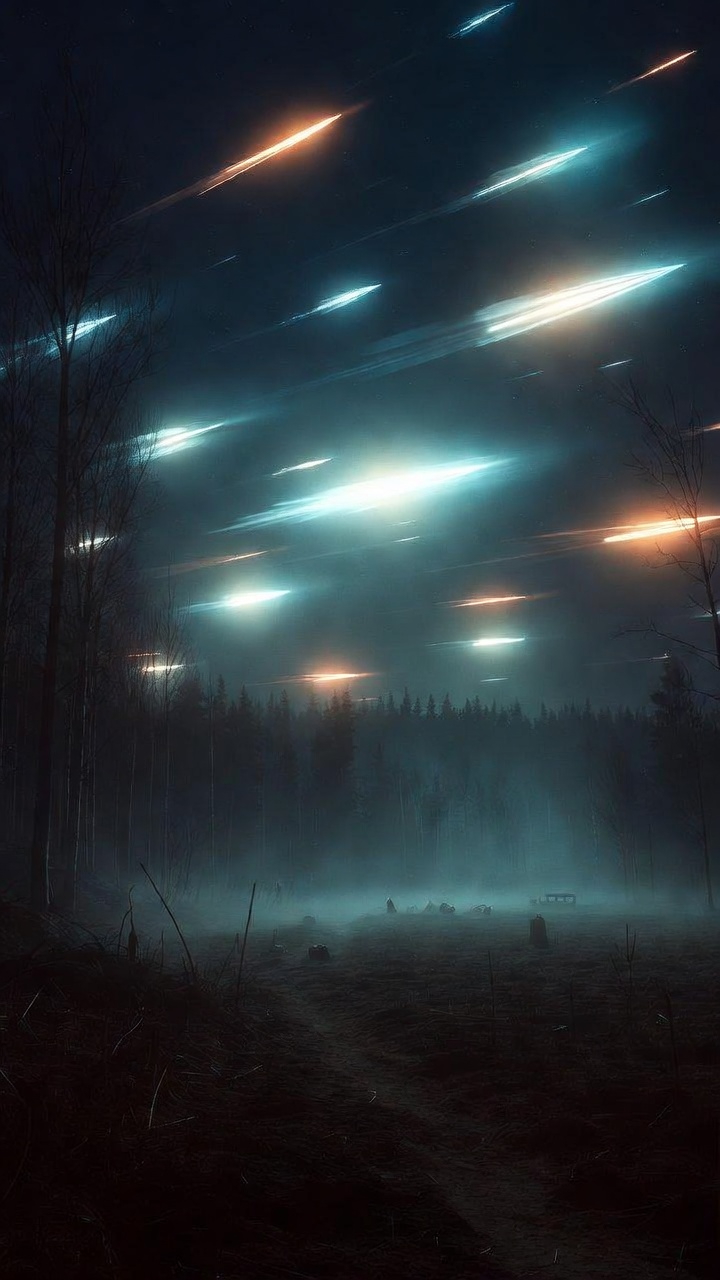
Discover the mysterious Ghost Rockets of 1946 – Sweden’s mass UFO sighting that sparked international investigations. Over 2,000 reports of unidentified flying objects left scientists baffled during the early Cold War era.
In the summer of 1946, the skies over Scandinavia became the stage for one of history’s most perplexing UFO phenomena. Thousands of Swedish citizens reported seeing mysterious rocket-like objects streaking across the sky, sparking military investigations and international concern during the tense early days of the Cold War.
What Were the Ghost Rockets?
The ”Ghost Rockets” (spökraketer in Swedish) were unexplained aerial phenomena that appeared primarily over Sweden and neighboring Nordic countries between May and December 1946. Witnesses described cigar-shaped or rocket-like objects, often silver or metallic in appearance, flying at high speeds and sometimes leaving vapor trails before disappearing or allegedly crashing into lakes and remote areas.
According to Swedish military archives, over 2,000 sightings were officially reported during this period, with peaks occurring in July and August 1946. The Swedish Defense Staff took these reports seriously enough to launch formal investigations, document witness testimonies, and search for physical evidence.
Historical Context: Post-War Anxiety
The timing of the Ghost Rockets phenomenon is crucial to understanding its impact. In 1946, World War II had just ended, and tensions between Western powers and the Soviet Union were escalating. Sweden, maintaining its position of neutrality, found itself geographically positioned between these emerging superpowers.
Initial speculation focused on the possibility that these objects were:
- Captured German V-2 rockets being tested by the Soviets
- Experimental Soviet weapons programs
- Advanced aircraft prototypes from unknown sources
- Natural phenomena misidentified due to wartime anxiety
As noted by historian Anders Liljegren, founder of Archives for the Unexplained (AFU), ”The Ghost Rockets represented Sweden’s first mass UFO phenomenon, predating the famous Kenneth Arnold sighting in the United States by nearly a year.”
Key Incidents and Eyewitness Accounts
The Lake Kölmjärv Incident (July 19, 1946)
One of the most investigated cases involved reports of a rocket-like object crashing into Lake Kölmjärv in northern Sweden. Military personnel conducted extensive searches using boats and diving equipment but found no debris or physical evidence. The Swedish military’s final report acknowledged the crash was witnessed by ”completely reliable persons” but offered no explanation for the lack of physical remains.
Mass Sightings Over Stockholm
On August 11, 1946, numerous witnesses in Stockholm reported seeing bright objects maneuvering in the sky. Newspaper archives from Dagens Nyheter and Svenska Dagbladet documented dozens of testimonies from credible witnesses including military officers, police, and civilian authorities.
The Njurunda Observation (August 12, 1946)
Perhaps the most detailed report came from Njurunda, where witnesses described a rocket-shaped object approximately 90 feet long, moving silently at low altitude before allegedly crashing into a lake. Despite immediate military response and searches, no wreckage was recovered.
Official Investigations and Military Response
The Swedish Defense Staff established a special committee to investigate the Ghost Rockets, led by senior military officials. Their efforts included:
- Collecting and cataloging witness testimonies
- Conducting searches of alleged crash sites
- Analyzing photographs and physical evidence
- Coordinating with radar stations and military observers
- Consulting with scientists and technical experts
International Dimensions
The phenomenon attracted international attention, with both American and British intelligence agencies monitoring the situation. Declassified documents from the U.S. Air Force, available through the National Archives, reveal that American military attachés in Stockholm reported on the incidents to Washington.
A U.S. Air Force intelligence report from August 1946 stated: ”For the past several weeks, there have been numerous reports of strange rocket-like missiles being seen in Swedish and Finnish skies.”
The British Air Ministry also took interest, as documented in files released under the Freedom of Information Act, showing concerns about potential Soviet weapons testing.
Scientific Analysis and Theories
Several explanations have been proposed over the decades:
The Soviet Rocket Theory
The most prevalent early theory suggested the objects were Soviet tests of captured German V-2 rockets. However, this explanation faced significant challenges:
- No rocket debris was ever conclusively recovered
- The flight patterns didn’t match known V-2 capabilities
- Soviet archives opened after the Cold War showed no evidence of such extensive testing over Sweden
Meteor and Natural Phenomena
Swedish astronomer Östen Bergstrand proposed that many sightings could be explained by an unusually active meteor shower period in 1946. However, this theory couldn’t account for:
- The controlled flight patterns described by witnesses
- Low-altitude sightings with detailed object descriptions
- Reports of objects changing direction mid-flight
Mass Hysteria and Misidentification
Skeptics have suggested a combination of wartime anxiety, media sensationalism, and misidentification of conventional aircraft. However, the sheer number of reports from credible witnesses, including trained military observers, makes this explanation incomplete.
The Official Swedish Conclusion
In 1948, the Swedish Defense Staff released their final report on the Ghost Rockets. The conclusion was remarkably candid:
”Most observations are vague and must be treated very skeptically. In some cases, the observations can be attributed to celestial bodies, particularly bright meteors… However, there remain a number of reports that cannot be dismissed, made by reliable observers of objects that do not fit any known category.”
This measured response acknowledged both the difficulty in verification and the genuine mystery surrounding certain incidents.
The Ghost Rockets in UFO History
The 1946 Ghost Rockets phenomenon holds a unique place in UFO history for several reasons:
- Preceded the Modern UFO Era: These events occurred a full year before Kenneth Arnold’s famous 1947 sighting in Washington state, which is typically credited with launching the modern UFO phenomenon in the United States.
- Government Documentation: Unlike many UFO reports, the Ghost Rockets were extensively documented by military authorities in real-time, creating a substantial official record.
- Mass Phenomenon: The scale of the sightings—over 2,000 reports in less than a year—made it impossible to dismiss as isolated incidents.
- International Impact: The phenomenon influenced early UFO investigations worldwide and contributed to the establishment of formal military protocols for investigating aerial phenomena.
Modern Research and Continuing Mystery
Contemporary researchers continue to study the Ghost Rockets phenomenon. The Archives for the Unexplained (AFU) in Norrköping, Sweden, maintains extensive documentation including original military reports, witness testimonies, and newspaper archives from the period.
Recent analyses using modern Geographic Information Systems (GIS) have mapped sighting patterns, revealing interesting clusters along Sweden’s eastern coast and over major lakes—patterns that don’t obviously correlate with known flight corridors or meteor trajectories.
Dr. Clas Svahn, current chairman of UFO-Sverige (Sweden’s primary UFO research organization), has noted: ”The Ghost Rockets remain one of Scandinavia’s greatest unsolved mysteries. Despite decades of research, we still cannot provide a definitive explanation for all the reported phenomena.”
Cultural Legacy
The Ghost Rockets left a lasting impact on Swedish culture:
- The term ”spökraket” entered the Swedish language as a descriptor for unexplained phenomena
- The events influenced Nordic science fiction literature and film
- Annual commemorations occur in some localities where significant sightings took place
- The phenomenon continues to inspire documentary filmmakers and researchers
Lessons from the Ghost Rockets
The 1946 Ghost Rockets phenomenon offers valuable insights for contemporary UFO research:
The Importance of Documentation: The Swedish military’s systematic approach to recording and investigating reports created a valuable historical record, regardless of the ultimate explanation.
The Challenge of Verification: Despite immediate military response and searches, physical evidence remained elusive—a pattern that continues in modern UFO investigations.
The Role of Context: The Cold War setting undoubtedly influenced both the perception of events and the official response, reminding us that cultural and political contexts shape how we interpret unexplained phenomena.
The Limits of Explanation: Sometimes, even with thorough investigation, phenomena remain unexplained—a conclusion that requires intellectual humility rather than forced explanations.
Conclusion
Nearly eight decades later, the Ghost Rockets of 1946 remain one of history’s most intriguing unsolved mysteries. Were they advanced Soviet weapons tests? Natural phenomena enhanced by post-war anxiety? Something more exotic? The honest answer is that we still don’t know.
What we do know is that thousands of Swedish citizens, including trained military observers and credible witnesses, reported seeing something unusual in their skies during that remarkable summer. The Swedish military took these reports seriously enough to conduct extensive investigations, and their findings—or lack thereof—continue to fascinate researchers worldwide.
The Ghost Rockets remind us that even in our age of advanced surveillance and technology, the skies can still hold mysteries that resist easy explanation. They represent a chapter in human history where the unknown confronted the known, and where the limits of our understanding became uncomfortably clear.
Related Reading:
- The Kenneth Arnold Sighting: How 1947 Launched the Modern UFO Era
- Cold War Secrets: Declassified Documents on Aerial Phenomena
- Scandinavia’s Most Mysterious Unsolved Cases
Sources and Further Reading:
- Swedish Defense Staff Archives, ”The Ghost Rockets Report” (1946-1948)
- Archives for the Unexplained (AFU), Norrköping, Sweden
- Liljegren, Anders. ”The Ghost Rockets of 1946” – AFU Publications
- U.S. National Archives, Declassified Air Force Intelligence Reports (1946)
- Svahn, Clas. ”UFO-Sverige Historical Database”
- Swedish National Archives, Military Intelligence Reports 1946
- Dagens Nyheter and Svenska Dagbladet newspaper archives (July-August 1946)
Keywords: Ghost Rockets 1946, Swedish UFO phenomenon, Scandinavia UFO history, unexplained aerial phenomena, Cold War mysteries, Swedish military investigations, spökraketer, Nordic UFO sightings, 1946 rocket sightings, historical UFO cases
Lämna ett svar