
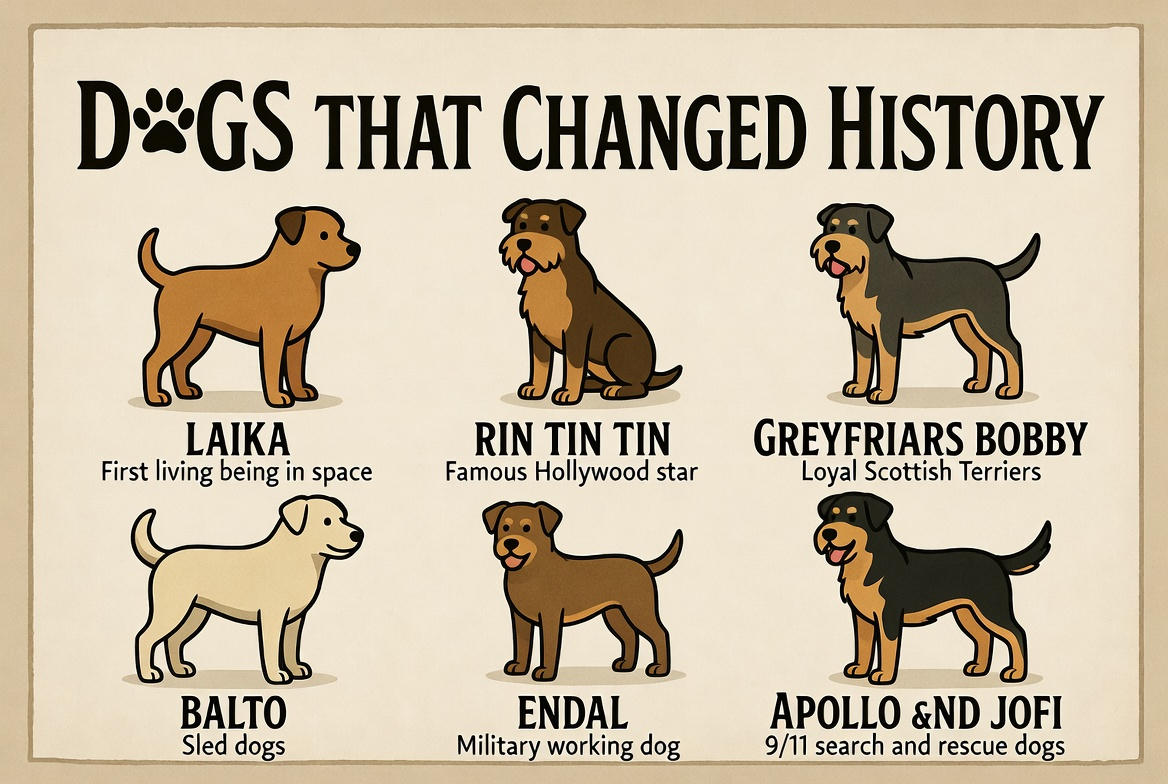
Seven Remarkable Dogs Who Left Their Paw Prints on Human History
By Historical Research Desk | Series: Animals in History | Reading time: ~12 minutes
Throughout recorded history, dogs have served as companions, workers, soldiers, and symbols. Beyond their roles as loyal pets, certain dogs have shaped the course of human events in ways that historians are only beginning to fully appreciate. From the frozen reaches of outer space to the glamour of 1920s Hollywood, from the battlefields of World War I to the quiet graveyards of Edinburgh — dogs have walked alongside humanity at its most pivotal moments.
This article examines seven extraordinary dogs whose lives intersected with history in ways that changed the world. Their stories span continents, centuries, and disciplines — from aerospace science to psychotherapy, from polar exploration to emergency medicine. Each dog on this list left the world measurably different from the one they entered.
”The dog is the only animal that has seen his god.” — French novelist Anatole France, Nobel Prize in Literature, 1921
The following profiles are drawn from primary historical sources, scientific literature, and established biographical accounts. Where historical records conflict, we have noted the discrepancy and presented the most widely accepted scholarly consensus.
1. Laika (c. 1954–1957) — The Dog Who Opened Space
Soviet Union · Space Exploration · Cold War Era
Species: Mixed breed (believed part Samoyed terrier) | Mission: Sputnik 2, November 3, 1957
On November 3, 1957, a small stray dog from the streets of Moscow became the first living creature to orbit Earth. She had no name when Soviet scientists found her — she was simply one of the stray dogs that populated Moscow’s cold streets, selected precisely because street dogs had demonstrated resilience to hunger, cold, and hardship that laboratory-raised animals lacked.
The Soviets named her Laika — Russian for ’barker’ — though she was also affectionately known in the Soviet press as Kudryavka (’Little Curly’). Her selection was part of a rapid, politically driven program to demonstrate Soviet technological superiority over the United States during the early Cold War. Soviet Premier Nikita Khrushchev demanded a second Sputnik launch within weeks of the first — leaving scientists almost no time to develop a safe mission.
”We did not learn enough from this mission to justify the death of the dog.” — Oleg Gazenko, one of Laika’s trainers, speaking publicly in 1998
The uncomfortable truth — suppressed by Soviet authorities for decades — was that there was never a plan to return Laika safely to Earth. The technology did not yet exist. Scientists estimated she survived approximately five to seven hours after launch before dying from overheating caused by a thermal control malfunction. The Soviet government originally claimed she survived for several days, a deception not publicly corrected until 2002.
Laika’s mission, despite its tragic end, provided critical data confirming that living organisms could survive the conditions of orbital spaceflight — data that directly enabled Yuri Gagarin’s historic human spaceflight in 1961. Without the physiological data gathered from Laika’s mission, the Soviet space program could not have proceeded with human missions on the timeline that defined the Space Race.
In 2008, Russian officials unveiled a monument to Laika near the military research facility in Moscow where she was trained. She remains one of the most recognized animals in human history, appearing on postage stamps from dozens of nations.
📚 Source: Anatoly Zak, ’Laika: The First Traveler,’ RussianSpaceWeb.com (2002); Oleg Gazenko interview, World Space Congress, 1998; Sputnik-2 mission records, Russian State Archive of Scientific and Technical Documentation
2. Rin Tin Tin (1918–1932) — The Dog Who Saved Hollywood
United States / France · Entertainment Industry · Post-WWI Era
Breed: German Shepherd | Films: 27 feature films (1922–1931)
In September 1918, American Army Corporal Lee Duncan stumbled upon a bombed-out German military dog kennel near Flirey, France, in the final weeks of World War I. Inside, barely alive amid the rubble, he found a litter of newborn German Shepherd puppies beside their wounded mother. Duncan took two puppies home to Los Angeles, naming them after small woolen finger puppets — ’Rintintin’ and ’Nénette’ — that French children traditionally gave to American soldiers as good luck charms.
Only one puppy, the male Duncan named Rin Tin Tin, survived to adulthood. Duncan’s obsessive daily training revealed a dog of exceptional intelligence and physical ability. By 1922, he had secured Rinty — as he was affectionately known — a film role at Warner Bros. that would change the trajectory of American cinema.
”Rin Tin Tin was the mortgage lifter of Warner Bros. Without him, there might not have been a Warner Bros.” — Film historian Cari Beauchamp
Warner Bros., then a financially precarious studio, found in Rin Tin Tin a bankable star who could fill theaters reliably at a time when the studio desperately needed revenue. Between 1923 and 1929, Rinty appeared in 26 Warner Bros. films, each a commercial success. His weekly fan mail exceeded 10,000 letters — more than any human actor of the era. Film historians including Susan Orlean, in her 2011 biography Rin Tin Tin: The Life and the Legend, argue that the studio’s survival through the 1920s was directly attributable to Rinty’s box office performance.
When sound cinema arrived with The Jazz Singer in 1927, many silent film stars found their careers destroyed by the transition. Rin Tin Tin successfully made the transition to sound films, extending his career and demonstrating the dog’s adaptability. He died in 1932, reportedly in the arms of actress Jean Harlow, who lived next door to Duncan in Hollywood.
His lineage continues today: a direct descendant named Rin Tin Tin XI serves as an ambassador for the breed and the story. The original Rin Tin Tin is buried in Paris, France — an irony that acknowledges both his American fame and his French origins.
📚 Source: Susan Orlean, Rin Tin Tin: The Life and the Legend (Simon & Schuster, 2011); Warner Bros. historical financial records cited in Schatz, Thomas, The Genius of the System (1988); American Kennel Club historical archives
3. Greyfriars Bobby (c. 1855–1872) — The Dog Who Guarded a Grave
Scotland · Victorian Era · Human-Animal Bond
Breed: Skye Terrier | Vigil Duration: 14 years (1858–1872)
Few stories in the entire canon of human-animal relations match the documented loyalty of Greyfriars Bobby. When Edinburgh night watchman John Gray died of tuberculosis in February 1858 and was buried in Greyfriars Kirkyard in Edinburgh’s Old Town, his small Skye Terrier refused to leave the graveside. Bobby maintained his vigil at Gray’s grave for the next fourteen years — through Scottish winters, through illness, through the persistent attempts of cemetery caretakers to remove him — until his own death in 1872.
Bobby’s vigil was not merely anecdotal. The story was documented contemporaneously by local journalist James Brown and by cemetery keeper James Brown (no relation), and was widely reported in the Edinburgh press during Bobby’s lifetime. The Lord Provost of Edinburgh, Sir William Chambers, personally arranged for Bobby to receive a special license exempting him from dog tax, effectively granting him official civic recognition. Chambers also funded the small granite drinking fountain and bronze statue of Bobby that was erected in 1873 at the corner of Candlemaker Row — the year after Bobby’s death.
”The story of Greyfriars Bobby is not sentiment. It is documented municipal history.” — Dr. Jan Bondeson, author of Amazing Dogs: A Cabinet of Canine Curiosities (2011)
The statue of Greyfriars Bobby still stands today and remains one of Edinburgh’s most visited landmarks. Bobby himself was buried just inside the gate of Greyfriars Kirkyard, near his owner’s grave — a location marked by a small red granite headstone donated by The Dog Aid Society of Scotland in 1981.
Some historians, notably Dr. Jan Bondeson of Cardiff University, have raised questions about certain aspects of the Bobby legend, suggesting that the dog living at the churchyard in the 1860s may have been a succession of similar-looking dogs maintained by local publicans for the considerable tourist trade Bobby attracted even during his lifetime. Whether or not this revisionist account is accurate, the core of the documented story — a dog who remained loyal to a grave for an exceptional period — is historically established.
📚 Source: Jan Bondeson, Amazing Dogs: A Cabinet of Canine Curiosities (Cornell University Press, 2011); National Records of Scotland, Edinburgh municipal records 1858–1872; Eleanor Atkinson, Greyfriars Bobby (1912)
4. Balto (1919–1933) — The Dog Who Saved a Town
United States (Alaska) · Public Health · The Great Race of Mercy
Breed: Siberian Husky / mixed sled dog | Mission: Nome Serum Run, January–February 1925
In January 1925, the remote coastal town of Nome, Alaska, population approximately 1,400, faced a diphtheria outbreak of potentially catastrophic proportions. The nearest supply of diphtheria antitoxin was in Anchorage, nearly 1,000 miles away. The Bering Sea was frozen solid, making Nome inaccessible by ship. The only aircraft available in Alaska was inoperable in the extreme cold. The only viable option was a dog sled relay across the frozen Alaskan interior — a journey that would become known as the Great Race of Mercy.
Twenty mushers and approximately 150 sled dogs participated in the relay across 674 miles of frozen terrain in temperatures reaching -50°F (-46°C). The final leg — the most dangerous, through a blizzard with near-zero visibility on the sea ice of Norton Sound — fell to musher Gunnar Kaasen and his lead dog, Balto.
”I did not do it alone. The credit belongs to Balto.” — Gunnar Kaasen, musher, speaking to reporters in Nome, February 2, 1925
Balto navigated the final stretch of approximately 53 miles through total darkness and blizzard conditions, reportedly finding the trail by scent when Kaasen could not see his hand in front of his face. The team arrived in Nome on February 2, 1925, delivering the antitoxin in time to prevent what health officials believed would have been a catastrophic epidemic.
Balto became a national hero. A bronze statue was erected in Central Park, New York City, in December 1925 — just ten months after the run. The statue, by sculptor Frederick Roth, still stands in its original location and continues to be one of Central Park’s most photographed landmarks. Balto himself toured the United States for several months before being purchased by a Cleveland businessman who had him displayed in a sideshow. Public outcry in Cleveland led to a fundraising campaign to buy his freedom; in 1927, Balto and his teammates were brought to the Cleveland Museum of Natural History, where Balto lived out his life in comfort until his death in 1933.
Today the Iditarod Trail Sled Dog Race, run annually since 1973, commemorates the route of the 1925 serum run. The mushers and dogs of the relay are honored at the race’s ceremonial start each year.
📚 Source: Gay and Laney Salisbury, The Cruelest Miles: The Heroic Story of Dogs and Men in a Race Against an Epidemic (W.W. Norton, 2003); Nome Nugget newspaper archives, February 1925; Smithsonian National Museum of Natural History
5. Endal (1995–2009) — The Most Decorated Service Dog in History
United Kingdom · Disability Rights · Modern Era
Breed: Yellow Labrador Retriever | Service Years: 1997–2009
Endal has been described by the Guinness World Records as ’the most decorated dog in the world.’ He was a yellow Labrador Retriever trained by Canine Partners who was partnered with Gulf War veteran Allen Parton, who had been left severely disabled following a head injury suffered during the 1991 Gulf War. Parton could not speak, could not remember his wife or children, and was confined to a wheelchair.
What made Endal historically significant was not merely his assistance work — it was the extraordinary cognitive abilities he demonstrated. Endal learned to understand over 100 signed commands — an unprecedented number at the time. He could operate elevator buttons, retrieve items from supermarket shelves when shown the packaging, use ATM machines, and had been filmed putting Parton into the recovery position when Parton was knocked from his wheelchair by a car, pulling a blanket over him and going for help.
”Endal single-handedly rebuilt our family. He gave me back my husband, and gave my children back their father.” — Sandra Parton, Allen’s wife
The depth of Endal’s impact on the field of assistance animals cannot be overstated. He was recognized with the PDSA’s Gold Medal — the animal equivalent of the George Cross — the Blue Cross Medal, the Golden Bone Award from Dogs Today magazine, and was named ’Dog of the Millennium’ by Dogs Today in 2000. His case was extensively studied by animal behaviorists and contributed significantly to understanding of canine cognition and the scope of what assistance animals are capable of.
Endal died in March 2009. His successor, a dog named EJ (Endal Junior), was trained to continue assisting Allen Parton. Endal’s story has been the subject of books, documentaries, and has been cited in parliamentary debates about the rights and provision of assistance animals in the United Kingdom.
📚 Source: Allen and Sandra Parton, Endal (HarperCollins, 2009); Canine Partners charity records; PDSA Gold Medal citation, 2002; Dogs Today Magazine, ’Dog of the Millennium’ award documentation
6. Apollo (1994–2006) — The First Hero of Ground Zero
United States · September 11, 2001 · Search & Rescue
Breed: German Shepherd | Handler: Officer Peter Davis, NYPD
On the morning of September 11, 2001, within fifteen minutes of the collapse of the World Trade Center’s North Tower, a German Shepherd named Apollo and his handler, NYPD Officer Peter Davis, arrived at Ground Zero. Apollo was the first officially certified search-and-rescue dog to reach the site — a designation that earned him recognition as the representative dog for all the search-and-rescue animals who worked the disaster.
Apollo nearly died within the first hour of his work. He fell through smoldering wreckage into flames and water, and was reportedly saved only because water from firefighters’ hoses doused him before the fire could take hold. He shook himself off and returned immediately to work — a moment witnessed and documented by several emergency workers on site.
”Apollo represents every dog who worked at Ground Zero — more than 300 of them. He is their symbol.” — PDSA Gold Medal citation, 2002
Over the following weeks, Apollo and his fellow search-and-rescue dogs — working in four-hour shifts due to the physical demands of the destroyed terrain — searched the ruins for survivors and, eventually, human remains. The psychological and physical toll on the dogs was significant; veterinary teams documented numerous cases of depression and respiratory illness among the working dogs in the weeks following the disaster.
In 2002, Apollo was awarded the PDSA Dickin Medal — often referred to as the ’animal Victoria Cross’ — on behalf of all search-and-rescue dogs who worked at the World Trade Center, the Pentagon, and in the fields of Pennsylvania following the September 11 attacks. The medal, established in 1943 by PDSA founder Maria Dickin, is the highest award any animal can receive for wartime or emergency service. Apollo accepted the medal as the symbolic representative of all 300+ dogs who served.
📚 Source: PDSA Dickin Medal citation, 2002; National September 11 Memorial & Museum archival records; W. David Marx, ’The Dogs of 9/11,’ The Atlantic, September 2011; American Kennel Club 9/11 working dog documentation
7. Jofi (c. 1930–1937) — The Dog Who Co-Invented Therapy
Austria / United Kingdom · Psychoanalysis · Sigmund Freud
Breed: Chow Chow | Owner: Sigmund Freud, Vienna / London
In the early 1930s, Sigmund Freud — by then in his seventies and suffering from the painful oral cancer that would eventually kill him — acquired a Chow Chow named Jofi, a gift from his daughter Anna. What began as a personal comfort for the aging father of psychoanalysis became, through Freud’s careful observation, the first documented clinical application of animal-assisted therapy in the history of psychotherapy.
Freud began allowing Jofi to sit in during his analytical sessions. He observed, and later wrote about, the measurable calming effect Jofi had on his patients. Anxious or agitated patients became demonstrably calmer in the dog’s presence. Children who were otherwise unable to communicate opened up more readily. Freud noted that Jofi seemed to move closer to patients who were distressed and withdraw from those who were well — behavior he found clinically useful as a real-time gauge of patient anxiety that supplemented his own observations.
”Dogs love their friends and bite their enemies, quite unlike people, who are incapable of pure love.” — Sigmund Freud, in a letter to his friend Marie Bonaparte, 1926
Freud was so taken with Jofi’s therapeutic value that he documented the phenomenon in his letters and in conversations recorded by his colleagues. The practice of involving animals in therapeutic settings — now formalized as Animal-Assisted Therapy (AAT) — is today recognized by the American Psychological Association and practiced in clinical settings worldwide. While the modern AAT field draws on decades of subsequent research, historians of psychology consistently trace its conceptual origins to Freud’s documented observations of Jofi.
When the Nazis annexed Austria in 1938, the Freud family fled to London. Jofi had died the previous year, in 1937, but Freud had by then acquired another Chow Chow, Lün. Freud died in London in September 1939, requesting euthanasia as his cancer became unbearable. His dogs are buried at Golders Hill Park in London, near the house where the family spent their final years.
📚 Source: Peter Gay, Freud: A Life for Our Time (W.W. Norton, 1988); Freud Museum London archival records; Cynthia K. Chandler, Animal-Assisted Therapy in Counseling (Routledge, 2017); Freud’s letters, Library of Congress digital collection
Conclusion: The Dogs History Forgot to Credit
The seven dogs profiled in this article span nearly a century of human history and every inhabited continent. They worked in space capsules and film studios, on frozen Alaskan tundra and the rubble of Manhattan. They served scientists, soldiers, studio executives, wheelchair users, and the father of modern psychiatry.
What unites them is not merely their relationship with famous humans or dramatic events — it is the measurable impact their lives had on the world that followed. Laika made human spaceflight safer. Rin Tin Tin preserved a studio that would go on to define American cinema. Balto delivered medicine that saved children’s lives. Endal redefined what the world expected from assistance animals. Apollo represented the silent, stoic contribution of hundreds of working dogs at America’s darkest moment. And Jofi — perhaps the most quietly consequential of all — helped establish a therapeutic practice that today benefits millions of people worldwide.
History tends to record the names of the humans who made decisions and gave orders. These seven dogs remind us that history is also made by those who simply showed up, did their work, and asked for nothing in return but perhaps a warm place to sleep.
”The bond with a dog is as lasting as the ties of this earth can ever be.” — Konrad Lorenz, On Aggression (1963)
📺 This Article Is Part of the ’Dogs That Changed History’ Video Series
Short-form video episodes for each dog in this series are available on our YouTube channel. Each episode explores the dog’s story in under 60 seconds, with historical animation and narration. Subscribe to follow the full 7-part series.
Tags: #DogsOfHistory #HistoricalAnimals #Laika #RinTinTin #GreyfriarsB obby #Balto #Endal #Apollo #Jofi #AnimalHistory #FamousDogs #DogLovers #HistoryFacts #AnimalAssistedTherapy #SpaceHistory #HollywoodHistory
Lämna ett svar